Recognition: a lever for engagement and motivation
 Recognition: a lever for engagement and motivation
Recognition remains an underused lever in the world of prevention… Let’s shift perspective and try to make use of this immense reservoir of progress and learning.
Positive and proactive contributions to safety make up most behaviors adopted by women and men in their work: complying with rules, taking initiatives, acting prudently, making appropriate adjustments in degraded situations, gestures of support and cooperation, spontaneous reporting of information, and more.
It is essential to value and recognize all these virtuous practices.
Why Recognition?
Recognition helps trigger a positive dynamic with regard to safety (and not only safety!).
It helps to:
-
develop motivation, engagement, creativity and proactivity within teams
-
foster a sense of usefulness and meaning at work
-
sustain virtuous practices
-
improve the quality of the relationship between manager and employee, etc.
Conversely, a lack of recognition has highly damaging effects: loss of meaning at work, loss of self-confidence, isolation, disengagement, psychosocial risks, turnover, absenteeism, voluntary departures, and more.

According to Gallup* research (2024), highly engaged teams record around 63% fewer safety incidents than teams with low engagement levels.
This shows a strong relationship between motivation and the number of workplace incidents.
*Gallup Organization is an American company conducting research on management, human resources and statistics.
A lever still underused
Recognition is a “poor relation” in the world of safety. Everyone agrees it is important… yet very few organizations have truly made it a pillar of their prevention strategy.
48 %
This is the proportion of people who respond “sometimes” or “almost never” to the question: “Does management recognize and value those who work safely?”
Source: Icsi Safety Culture Diagnostics (2020–2025, 80,000 respondents)
So why doesn’t recognition really take hold in practice?
Several explanations are possible:
- a cultural bias: focusing on what is not working, assuming that “doing your job well is normal” (and if so, why recognize it?)
- recognition is often associated with HR rather than prevention, and hasn’t yet fully permeated safety culture,
- difficulty moving from principle to action: people often don’t know how to go about it.
What should be recognized?
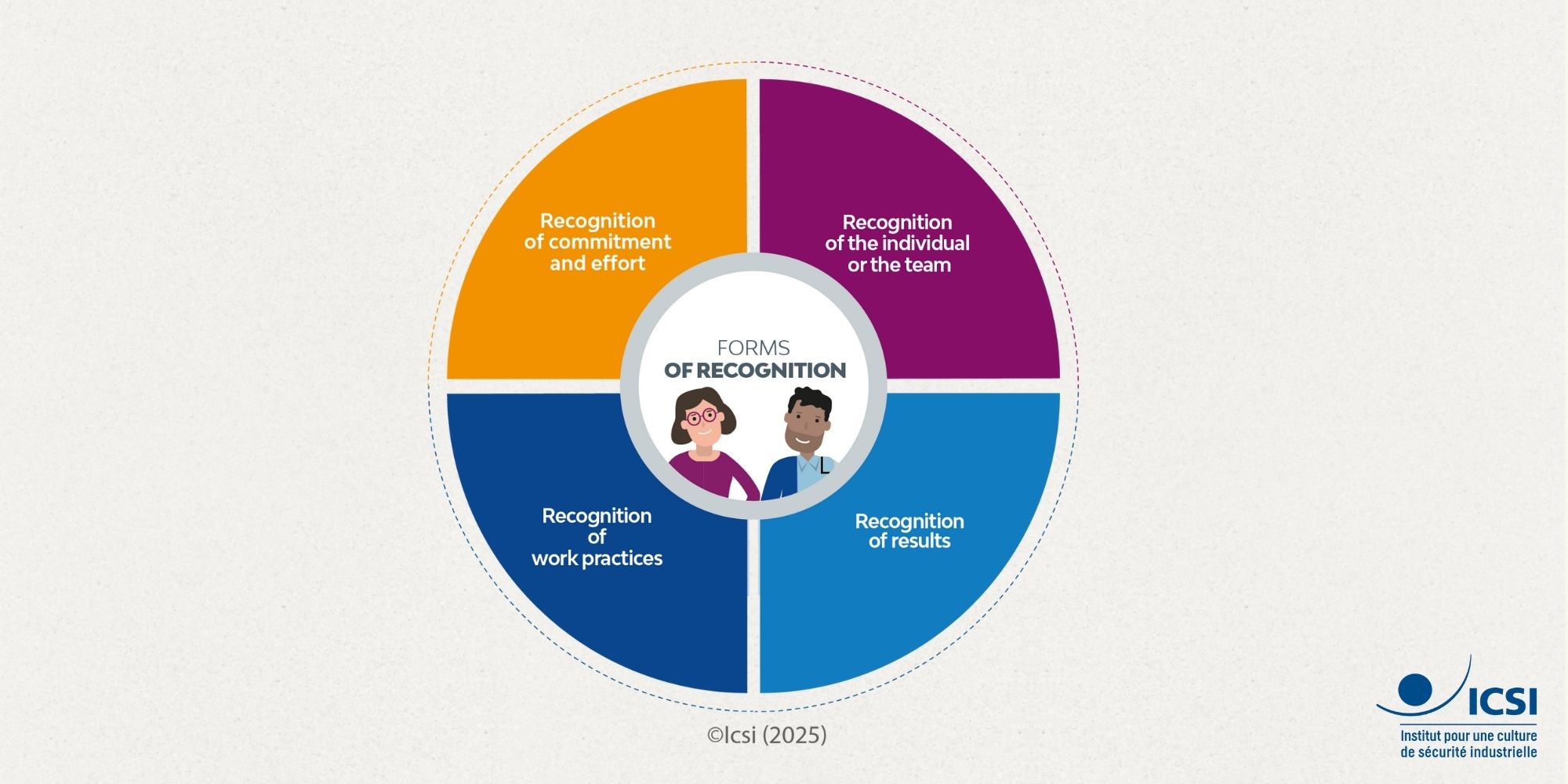
There is a wide range of attitudes, values and practices worth highlighting. According to Jean-Pierre Brun, Professor at Laval University (Canada) and expert at Empreinte Humaine, recognition may focus on:
-
personal or team qualities, for who they are, not only for what they produce (e.g. awareness of risks, vigilance for oneself and others)
-
work practices (methods, organization, efficiency, innovation in task performance)
-
investment in work (engagement, dedication, personal effort)
-
results (meeting objectives, contributing to the organization’s performance)
Warning: don’t put all your eggs in one basket! For example, if you only reward results, you may foster a competitive atmosphere between individuals and/or teams. What you choose to recognize sends a clear signal to employees about your expectations. Choose wisely!
How to recognize?
There are:
- Formal practices: employee-of-the-month schemes, skills development, promotions, financial rewards (bonuses), internal communication articles, company thank-you letters, etc.
- Informal practices: everyday encouragement and thanks, showing interest in the real work done (visits, questions, etc.), being consulted and listened to, being involved in decision-making, having autonomy, etc. Informal recognition is a lever that must not be overlooked.
Both types of practices matter: they complement each other.
Key points for progress
- Recognition is not only the manager’s responsibility
Recognition is often thought of as “managerial recognition”. And managers are indeed key actors—but they are not the only ones! Recognition may come from colleagues, the organization and its representatives, or even external parties (clients, contractors, etc.). - Everyone needs recognition
Everyone needs it—at every hierarchical level, right up to the very top of the organization. Valuing decisions and trade-offs made in favor of safety by managers at all levels is a powerful lever for progress. - Teams also need to be recognized
To promote cooperation and team spirit, why not complement individual recognition with collective recognition? After all, safety is everyone’s business. - Each person is different
When it comes to recognition (as with so many other things), copy-and-paste doesn’t work! Needs differ from one individual to another. For example, some will appreciate recognition for results, while others will be moved by acknowledgment of their efforts and perseverance. Some are very sensitive to informal recognition; others value financial rewards above all else. The key (which is no secret): listen to your teams and colleagues. Proximity is essential to get it right.